Analyzing the impact of equitable urban service distribution on citizen mobility: a spatial justice perspective

Volume 9, Issue 4 - Serial Number 36
Autumn 2024
Pages 653-670

Document Type : ORIGINAL RESEARCH ARTICLE

Authors

1 Department of Urbanism, Faculty of Architecture and Urbanism, Ferdowsi University of Mashhad, Iran

2 Department of Urban Engineering, Faculty of Art, University of Bojnord, Iran

Abstract
BACKGROUND AND OBJECTIVES: Achieving spatial-place justice in the distribution of urban services is a significant goal for urban planners. It involves ensuring fair and equitable access to resources and services in a physical space so that all individuals can benefit equally from the facilities and opportunities provided in that space. The unfair distribution of urban services has curtailed the presence of pedestrians and limited the daily mobility of citizens, making cities low-mobility environments. To address this issue, urban managers can identify local community issues, create equal opportunities, and promote public participation. By doing so, they can achieve spatial equity in local communities and provide opportunities for equality and justice. This research aims to investigate the relationship between the fair spatial-place distribution of urban services and the mobility of citizens in the Navid and Ab o Bargh areas of Mashhad.
METHODS: This study utilizes a descriptive-analytical approach to investigate spatial justice. Data was collected using the spatial justice questionnaire based on the Likert scale and the International Physical Activity Questionnaire. Researchers assessed the questionnaire's reliability using Cronbach's alpha test and its validity using the content validity coefficient of the item formula. The researchers employed several statistical methods to explore the relationship and correlation between the components of spatial justice and mobility, prioritized the indicators of spatial justice by neighborhoods, and compared the prioritization of the components of spatial justice affecting mobility.
FINDINGS: The results revealed a significant relationship between access to urban services and the mobility of citizens in the studied areas. As such, the positive correlation in the Ab o Bargh area was confirmed for all indicators (functional index (0.466), environmental indicator, (0.384) index aesthetic indicator (0.145). The results suggested a direct relationship between the balanced spatial distribution of urban services and enhanced mobility of citizens in the study area.
CONCLUSION: Research results show a direct relationship between spatial justice and citizen mobility in the city. Spatial justice means the fair distribution of facilities and services between different urban areas and equal access to them by citizens. As a result, citizen mobility in the city is influenced by spatial justice. In other words, Inappropriate distribution of services in the city can cause social differences among citizens. The difference between privileged and underprivileged neighborhoods is in the amount of benefit from urban services. By improving the quality of research indicators in the form of policies and urban planning interventions in all neighborhoods, spatial justice can be realized.

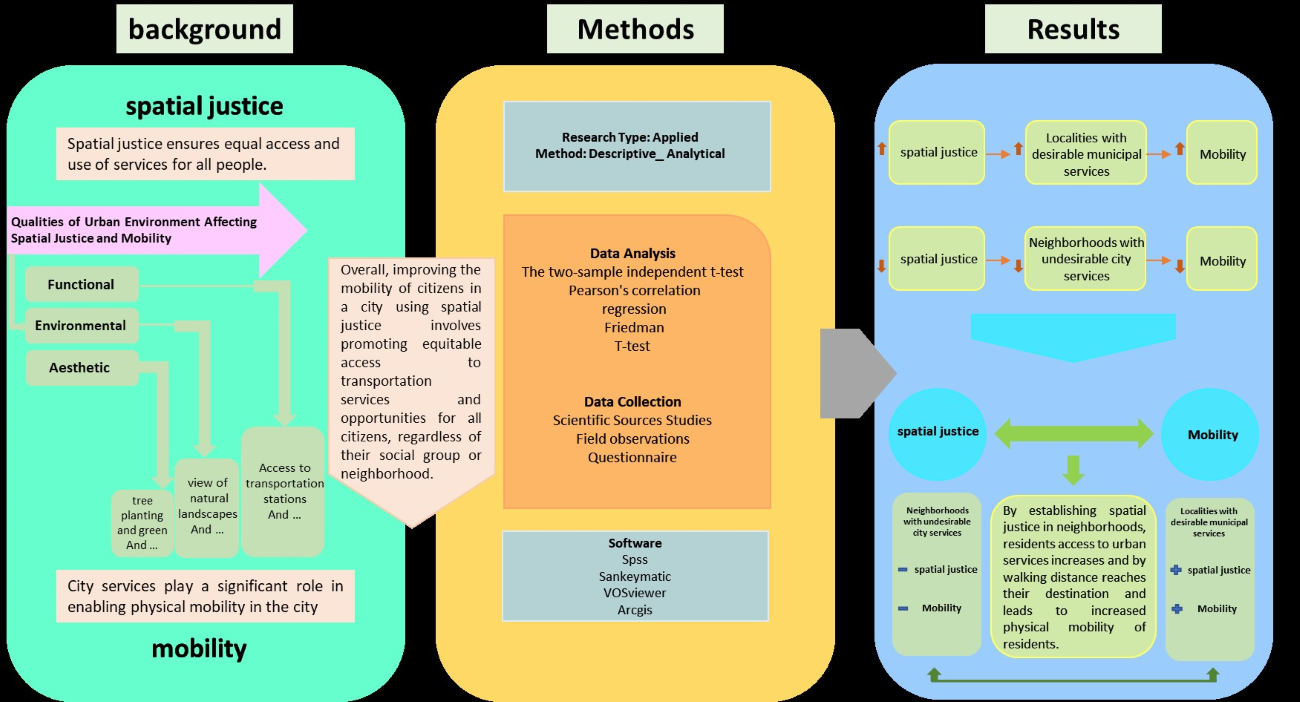
Graphical Abstract

Analyzing the impact of equitable urban service distribution on citizen mobility: a spatial justice perspective

Keywords

Subjects
 Pourahmad, A., Zanganeh Sgahraki, S., Saberi, A., (2023). Analysis of Spatial Justice in Access to Urban Services Case study: Yasouj city. Geography and Development., 21(71): 1-32 (32 pages). (In Persian)
  • Receive Date 18 October 2023
  • Revise Date 07 April 2024
  • Accept Date 23 April 2024