Document Type : ORIGINAL RESEARCH ARTICLE
Authors
1
Department of Futures Studies, Kish International Campus, University of Tehran, Tehran, Iran
2
Department of Public Policy and Administration, Faculty of Public Administration and Organizational Science, College of Management, University of Tehran, Tehran, Iran
3
Department of Futures Studies, Faculty of Governance, University of Tehran, Tehran, Iran
4
College of Management, University of Tehran, Tehran, Iran.
Abstract
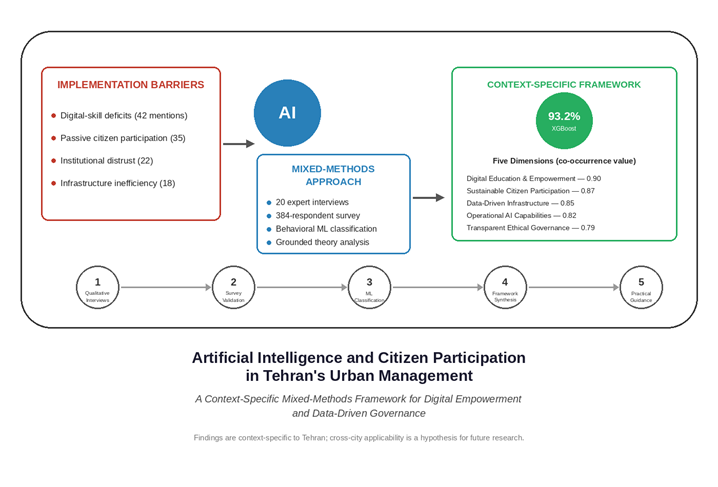
BACKGROUND AND OBJECTIVES: Rapid urban growth and increasing social and infrastructural complexity are placing growing pressure on metropolises worldwide, and conventional approaches to citizen engagement and human capital development are increasingly insufficient to address these pressures. Although artificial intelligence has shown considerable promise for urban management, most existing research emphasizes technical implementation rather than how AI can be integrated with participatory governance to genuinely support citizen empowerment. Guided by this gap, the present study examines how AI-related capabilities, digital empowerment, and citizen participation are interrelated in the urban management of Tehran, and develops a context-specific framework for explaining the factors associated with participation in AI-enabled urban systems. The study does not claim to measure human-capital enhancement directly over time; rather, it explains the mechanisms through which AI and data-driven governance can support digital capacities and participatory potential.
METHODS: We employed an exploratory sequential mixed-methods design in which the qualitative phase directly informed the quantitative phase. Twenty semi-structured interviews with urban-management experts, policymakers, information-technology professionals, and AI researchers were analyzed using grounded theory; the resulting codes and categories were used to construct the items of a questionnaire subsequently administered to 384 respondents (citizens and urban managers) in Tehran, with overall instrument reliability of Cronbach's alpha = 0.87. As a complementary technological layer, behavioral data from active users of municipal digital platforms were analyzed using a multilayer neural network, random forest, and XGBoost to classify participation patterns; citizens, urban managers, and digital-platform users were treated as distinct respondent groups throughout.
FINDINGS: Among the machine-learning models tested, XGBoost achieved the highest predictive accuracy (93.2%, AUC = 0.964) for classifying participatory behavior from platform-usage data; this result reflects predictive performance only and should not be read as a direct measure of human-capital enhancement. The qualitative analysis identified five interrelated dimensions of AI-enabled participation - digital education and empowerment, sustainable citizen participation, data-driven infrastructure, operational AI capabilities, and transparent ethical governance - with descriptive code co-occurrence values ranging from 0.79 to 0.90 across dimensions. These values represent the mean Jaccard co-occurrence coefficient across all sub-code pairs within each dimension (computed from MAXQDA's Code Relations Browser output) and should not be interpreted as statistical correlations, structural-equation path coefficients, or causal relationships. The qualitative analysis also identified four recurring implementation barriers, discussed most frequently in relation to digital-skill deficits (42 mentions), institutional constraints (35 mentions), technological limitations (31 mentions), and ethical concerns (26 mentions); these frequencies are treated as indicative of salience in expert discourse rather than as a standalone measure of theoretical importance.
CONCLUSION: Realizing AI-supported human-capital development in urban governance requires addressing interlinked technical, institutional, social, and cultural barriers. Because the empirical evidence comes from a single metropolis and digitally active platform users, the findings are best understood as context-specific to Tehran; their applicability to other developing-country metropolises is a hypothesis for future comparative research rather than a conclusion demonstrated by the present data. Within this scope, the proposed framework points to actionable directions - strengthening bidirectional communication channels, transparent algorithmic processes, and continuous feedback between citizens and urban administrators - while underscoring the importance of algorithmic transparency and safeguards against digital exclusion as AI-enabled urban services expand.
Graphical Abstract
Keywords
Subjects
OPEN ACCESS
©2027 The author(s). This article is licensed under a Creative Commons Attribution 4.0 International License, which permits use, sharing, adaptation, distribution and reproduction in any medium or format, as long as you give appropriate credit to the original author(s) and the source, provide a link to the Creative Commons license, and indicate if changes were made. The images or other third-party material in this article are included in the article’s Creative Commons license, unless indicated otherwise in a credit line to the material. If material is not included in the article’s Creative Commons license and your intended use is not permitted by statutory regulation or exceeds the permitted use, you will need to obtain permission directly from the copyright holder. To view a copy of this license, visit:
http://creativecommons.org/licenses/by/4.0/
PUBLISHER NOTE
Tehran Urban Research & Planning Centre (TURPC) takes a neutral position about claims on disputed territories, place names, international boundaries, jurisdiction in published maps, and institutional affiliations. TURPC is committed to retracting a paper after its publication if it becomes apparent that there are serious problems in its content, in terms of research and publication ethics (https://www.ijhcum.net/journal/process?ethics).
CITATION METRICS & CAPTURES
Google Scholar | DOAJ | Scopus | EBSCO | Internet Archive |Twitter |Mendeley
CURRENT PUBLISHER
Tehran Urban Research and Planning Center: Tehran Municipality