Document Type : CASE STUDY
Authors
1
Research Center for Industrial Systems and Sustainable Manufacturing, National Research and Innovation Agency, Tangerang Selatan 15314, Indonesia
2
Directorate of Environment, Maritime, Natural Resources and Nuclear Policy, National Research and Innovation Agency, Jakarta 10310, Indonesia
3
Centre for Research in Development, Social and Environment, Faculty of Social Sciences and Humanities, Universiti Kebangsaan Malaysia, 43600 Bangi, Selangor, Malaysia
4
Faculty of Agriculture, Jenderal Soedirman University, Purwokerto 53125, Central Java, Indonesia
5
Research Center for Behavioral and Circular Economy, National Research and Innovation Agency, South Tangerang 15314, Indonesia
6
Research Center for Environmental and Clean Technologies, National Research and Innovation Agency, South Tangerang 15314, Indonesia
Abstract
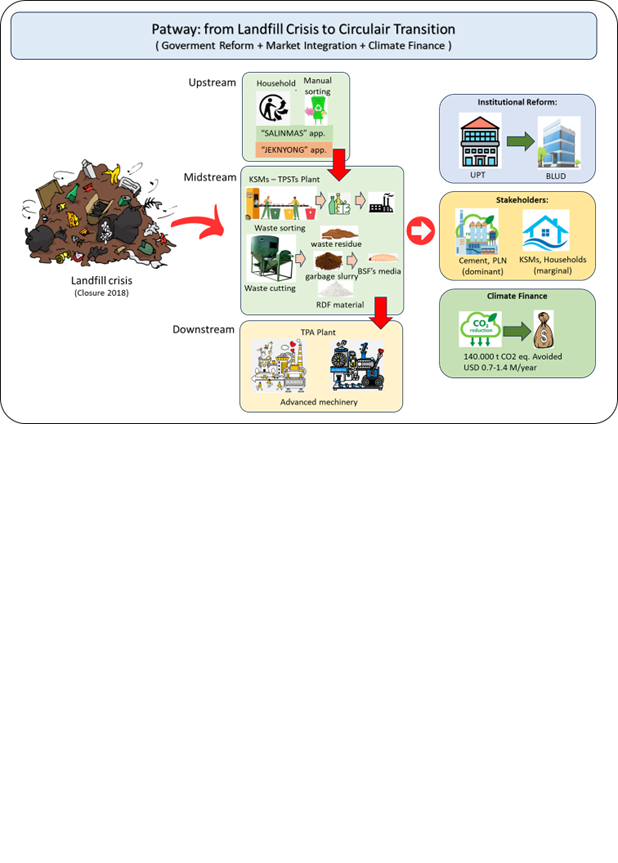
BACKGROUND AND OBJECTIVES: Decentralized waste governance in resource-constrained regions presents complex challenges where infrastructural expansion alone does not guarantee systemic resilience. Banyumas Regency, Indonesia, provides a critical case: following the abrupt landfill closure in 2018, the local government launched the “Sumpah Beruang” program, which initially reduced landfill-bound waste by over 90 percent. However, persistent inefficiencies such as underutilized facilities, stockpiled refuse-derived fuel, and declining digital engagement exposed governance and market fragilities. This study aims to evaluate the effectiveness of Banyumas’s Zero Waste strategy by examining its institutional adaptability, financial resilience, and stakeholder dynamics, while situating its relevance within broader circular economy transitions in decentralized settings.
METHODS: A convergent mixed-methods approach was applied, combining policy content analysis, institutional scoring, and financial benchmarking. Primary data were obtained through 20 semi-structured interviews with government officials, waste operators, community-based waste groups, and industrial off-takers. Secondary data included facility operations, household surveys, and municipal records. Comparative benchmarking with international refuse-derived fuel systems and institutional frameworks was undertaken. Triangulation ensured validity across qualitative narratives, operational statistics, and economic indicators.
FINDINGS: Results show significant upstream-midstream trade-offs. While landfill diversion exceeded 90%, facility utilization averaged only 58.25%, and over 160,000 tons of refuse-derived fuel remained unsold due to unstable quality and limited market absorption. This paradox underscores the fragility of end-of-pipe solutions in circular economy contexts. Institutional assessment revealed the local public service agency governance model scored substantially higher (4.35/5) compared to the technical implementation unit system (2.7/5), suggesting improved fiscal autonomy and partnership flexibility. Stakeholder mapping highlighted asymmetrical power: cement factories and the state electricity company dominate refuse-derived fuel markets, while community-based waste management groups and households remain marginal actors. Financial analysis showed revenue dependency on household fees (more than 85%), leaving the system vulnerable to non-compliance. Scenario modeling indicated that refuse-derived fuel co-firing could reduce up to 140,000 tons of carbon dioxide equivalent annually, representing United States Dollar 0.7–1.4 million in potential climate finance revenue if integrated with global carbon markets.
CONCLUSION: The study reveals that transforming the current technical implementation unit model into a public service agency significantly enhances fiscal autonomy and stakeholder coordination. We propose an integrated framework combining institutional reform, digital citizen engagement, and climate finance instruments. As a single case study focused on Banyumas Regency, the findings may have limited generalizability to regions with different governance or market contexts.
Graphical Abstract
Keywords
Subjects
OPEN ACCESS
©2026 The author(s). This article is licensed under a Creative Commons Attribution 4.0 International License, which permits use, sharing, adaptation, distribution and reproduction in any medium or format, as long as you give appropriate credit to the original author(s) and the source, provide a link to the Creative Commons license, and indicate if changes were made. The images or other third-party material in this article are included in the article’s Creative Commons license, unless indicated otherwise in a credit line to the material. If material is not included in the article’s Creative Commons license and your intended use is not permitted by statutory regulation or exceeds the permitted use, you will need to obtain permission directly from the copyright holder. To view a copy of this license, visit:
http://creativecommons.org/licenses/by/4.0/
PUBLISHER NOTE
Tehran Urban Research & Planning Centre (TURPC) takes a neutral position about claims on disputed territories, place names, international boundaries, jurisdiction in published maps, and institutional affiliations. TURPC is committed to retracting a paper after its publication if it becomes apparent that there are serious problems in its content, in terms of research and publication ethics (https://www.ijhcum.net/journal/process?ethics).
CITATION METRICS & CAPTURES
Google Scholar | DOAJ | Scopus | EBSCO | Internet Archive |Twitter |Mendeley
CURRENT PUBLISHER
Tehran Urban Research and Planning Center: Tehran Municipality