Document Type : ORIGINAL RESEARCH ARTICLE
Authors
1
Management Department, College of Business Studies, Public Authority for Applied Education and Training (PAAET), Ardiya, Kuwait.
2
Computing Department, College of Business Studies, Public Authority for Applied Education and Training (PAAET), Ardiya, Kuwait.
3
Business and Communication, INTI International University, Nilai, Malaysia
4
Business, Accounting, Finance, Law & Humanity (FOBAFLH), MAHSA University, Bandar Saujana Putra, Malaysia.
Abstract
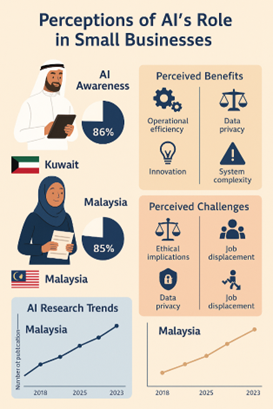
BACKGROUND AND OBJECTIVES: As artificial intelligence increasingly transforms business potential, its adoption in small businesses has become a growing interest. This study explores college students’ perceptions of artificial intelligence in the context of small businesses, comparing insights from Kuwait and Malaysia. With small businesses playing a pivotal role in the economic growth of both countries, understanding how future employees perceive artificial intelligence can provide valuable guidance for educators, entrepreneurs, and policymakers. The research aims to investigate key factors such as artificial intelligence awareness, perceived benefits and challenges, willingness to adopt artificial intelligence technologies, and the perceived effectiveness of artificial intelligence in improving business operations. In addition, a bibliometric analysis was conducted to compare the research trends and national emphasis on artificial intelligence in business within the two countries.
METHODS: A quantitative research approach was employed using a structured survey distributed to a total of 834 university students from Kuwait and Malaysia. The survey collected data on various dimensions, including artificial intelligence awareness, perceived utility, anticipated challenges, and readiness to engage with artificial intelligence in small business settings. The data were statistically analyzed to determine significant differences and similarities across the two national contexts. Also, a bibliometric analysis was carried out to explore the scholarly output and collaboration trends related to artificial intelligence and business in both countries.
FINDINGS: Statistical analysis of the survey data from 834 students (433 from Malaysia and 401 from Kuwait) revealed high mean scores across all constructs, ranging from 3.90 to 4.08 on a 5-point Likert scale, indicating overall positive perceptions of AI’s role in small businesses. Independent-samples t-tests showed no significant differences (p > 0.05) between the two countries regarding AI awareness, perceived benefits, anticipated challenges, willingness to adopt AI, and perceived impact on SMEs. Reliability coefficients (Cronbach’s α) for the constructs ranged from 0.73 to 0.86, confirming internal consistency. Additionally, bibliometric analysis showed that Malaysia produced 105 relevant publications from 2010–2024, with 1,872 total citations, while Kuwait produced 10 publications from 2018–2024, with 234 citations. Despite fewer publications, Kuwait demonstrated higher average citations per paper (23.4 vs. 17.83), indicating a high-impact research contribution.
CONCLUSION: This study underscores the universal recognition of artificial intelligence's value in small businesses among young professionals in Kuwait and Malaysia. The findings highlight the need for context-sensitive policies, focused artificial intelligence education, and hands-on support mechanisms for small enterprises. Cross-cultural collaboration and targeted research initiatives are recommended to responsibly harness artificial intelligence’s potential and drive sustainable innovation in the small business sector.
Graphical Abstract
Keywords
Subjects
OPEN ACCESS
©2026 The author(s). This article is licensed under a Creative Commons Attribution 4.0 International License, which permits use, sharing, adaptation, distribution and reproduction in any medium or format, as long as you give appropriate credit to the original author(s) and the source, provide a link to the Creative Commons license, and indicate if changes were made. The images or other third-party material in this article are included in the article’s Creative Commons license, unless indicated otherwise in a credit line to the material. If material is not included in the article’s Creative Commons license and your intended use is not permitted by statutory regulation or exceeds the permitted use, you will need to obtain permission directly from the copyright holder. To view a copy of this license, visit:
http://creativecommons.org/licenses/by/4.0/
PUBLISHER NOTE
Tehran Urban Research & Planning Centre (TURPC) takes a neutral position about claims on disputed territories, place names, international boundaries, jurisdiction in published maps, and institutional affiliations. TURPC is committed to retracting a paper after its publication if it becomes apparent that there are serious problems in its content, in terms of research and publication ethics (https://www.ijhcum.net/journal/process?ethics).
CITATION METRICS & CAPTURES
Google Scholar | DOAJ | Scopus | EBSCO | Internet Archive |Twitter |Mendeley
CURRENT PUBLISHER
Tehran Urban Research and Planning Center: Tehran Municipality