Document Type : ORIGINAL RESEARCH ARTICLE
Authors
1
Department of Management Studies, Sri Vidya Mandir Arts and Science College, Uthangarai, Tamil Nadu, India
2
Department of Agricultural Engineering, Kalasalingam Academy of Research and Education, Krishankoil, Tamil Nadu, India
3
Department of Environmental Health Engineering, Tehran University of Medical Sciences, Tehran, Iran
4
1137 Spectrum, Irvine, Orange County 92618 USA
Abstract
BACKGROUND AND OBJECTIVE: Krishnagiri is a significant hub for mango cultivation, primarily producing varieties like 'Banginapalli,' 'Alphonso,' and 'Thothapuri.' Despite the region’s favorable agro-climatic conditions, mango farming faces several challenges, including climate variability, inadequate infrastructure, and limited technology adoption. This study aims to analyze the dynamics of the mango supply chain in Krishnagiri, focusing on technology adoption, market access, infrastructure challenges, and government policies, with the primary objectives of identifying key barriers, assessing technology usage, and recommending interventions to enhance supply chain efficiency.
METHODS: A mixed-methods methodology was employed, combining quantitative, qualitative, and mixed-methods analyses. Quantitative data were collected through structured surveys with 150 mango farmers, 80 traders, and 30 government officials. The survey included Likert-scale and multiple-choice questions covering technology adoption, market access, and infrastructure. Qualitative data were gathered through in-depth interviews, focus group discussions, and field visits, providing deeper insights into stakeholder perceptions and challenges. Statistical tools like the Statistical Package for the Social Sciences and Excel were used for data analysis.
RESULTS: The results show that 60% of farmers sell locally, 25% engage in export, and 15% rely on intermediaries. Technology use is low, with 68% reporting minimal digital tool adoption and only 12% using the Internet of Things or blockchain. Barriers to adoption affect 58%, with cost being the main issue for 40%. Infrastructure gaps are significant: 70% report inadequate cold storage, and 65% face transport issues like delays and poor roads, contributing to post-harvest losses. Water scarcity affects 62% due to groundwater overuse, and 45% report pest issues, mainly fruit flies and powdery mildew. Policy feedback is mixed, with 52% viewing government policies as effective while 48% cite poor local implementation. Encouragingly, 78% are willing to adopt new technologies if subsidized. Smart tech adoption remains low (mean 33.6%, benefit 27.4%, variance 32.64 and 31.04), and 55.6% are affected by logistics issues (severe impact variance 69.04). Farmer engagement shows high inconsistency (variance 356.9 vs. traders’ 236.97), with positively skewed data emphasizing the need for targeted support.
CONCLUSION: The conclusion should highlight the importance of promoting digital tools and smart technologies, increasing Internet of Things and blockchain adoption (12%) through subsidies and digital literacy. By deploying smart logistics, it must address infrastructure gaps, with 70% lacking cold storage and 65% facing transport delays. Enhancing market access beyond local sales (60%) via Information and Communication Technology linkages is vital. Policy support through subsidies, awareness, and local implementation is needed. Future research should assess long-term tech adoption and policy impacts on urban resilience and smallholder sustainability.
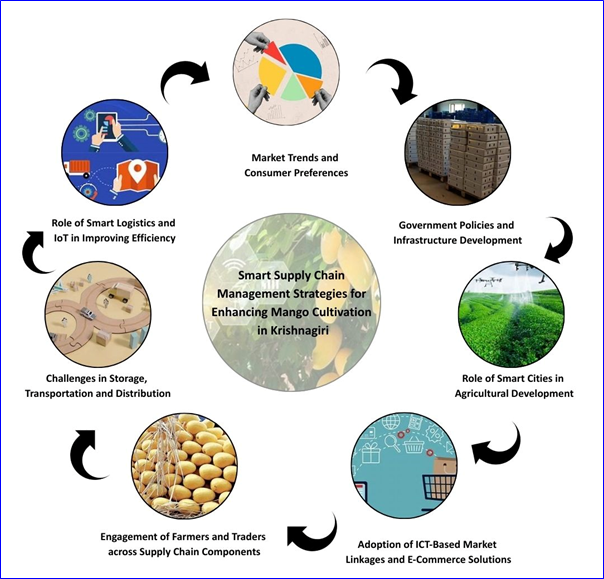
Graphical Abstract
Keywords
Subjects
OPEN ACCESS
©2026 The author(s). This article is licensed under a Creative Commons Attribution 4.0 International License, which permits use, sharing, adaptation, distribution and reproduction in any medium or format, as long as you give appropriate credit to the original author(s) and the source, provide a link to the Creative Commons license, and indicate if changes were made. The images or other third-party material in this article are included in the article’s Creative Commons license, unless indicated otherwise in a credit line to the material. If material is not included in the article’s Creative Commons license and your intended use is not permitted by statutory regulation or exceeds the permitted use, you will need to obtain permission directly from the copyright holder. To view a copy of this license, visit:
http://creativecommons.org/licenses/by/4.0/
PUBLISHER NOTE
Tehran Urban Research & Planning Centre (TURPC) takes a neutral position about claims on disputed territories, place names, international boundaries, jurisdiction in published maps, and institutional affiliations. TURPC is committed to retracting a paper after its publication if it becomes apparent that there are serious problems in its content, in terms of research and publication ethics (https://www.ijhcum.net/journal/process?ethics).
CITATION METRICS & CAPTURES
Google Scholar | DOAJ | Scopus | EBSCO | Internet Archive |Twitter |Mendeley
CURRENT PUBLISHER
Tehran Urban Research and Planning Center: Tehran Municipality