Document Type : ORIGINAL RESEARCH ARTICLE
Authors
1
Institute of Architecture and Urbanism, University of Batna 1, Batna, Algeria.
2
Laboratory of Architecture, Urban Planning and Transport: Housing, Landscape and Urban Mobility (LAUTr), University of Batna 1, Batna, Algeria.
3
Laboratory of Natural Risk Land Use Planning (LARNAT), University of Batna 1, Batna, Algeria
4
Laboratory of Bioclimatic Architecture and the Environment (ABE), Constantine 3 University, Constantine, Algeria.
Abstract
BACKGROUND AND OBJECTIVES: In Algerian cities, access to and use of public spaces remain strongly conditioned by cultural norms, gender stereotypes, and spatial inequalities. Women are often perceived as less legitimate users of public space, resulting in unequal access, limited visibility, and a heightened sense of vulnerability. This research explores how collective representations, particularly gendered social expectations, cultural constraints, and socio-spatial dynamics, shape women’s behaviors and restrict their appropriation of public space. Grounded in gender-sensitive placemaking, the study seeks to identify key obstacles and planning-related challenges while proposing inclusive urban strategies.
METHODS: The study adopts an anthropological and reflexive methodology, combining a literature review with mixed methods. It integrates qualitative interviews, field observations, and a structured survey of 100 women in the Ben-Boulaid alleys of Batna, Algeria. The empirical strategy was designed to investigate how cultural expectations, spatial arrangements (lighting, accessibility, urban design), and socio-economic characteristics (age, occupation, mobility) intersect to shape gendered uses of public space. This methodological framework allows for testing the assumption that these factors play a decisive role in producing spatial inequalities and limiting women’s access and autonomy in urban environments.
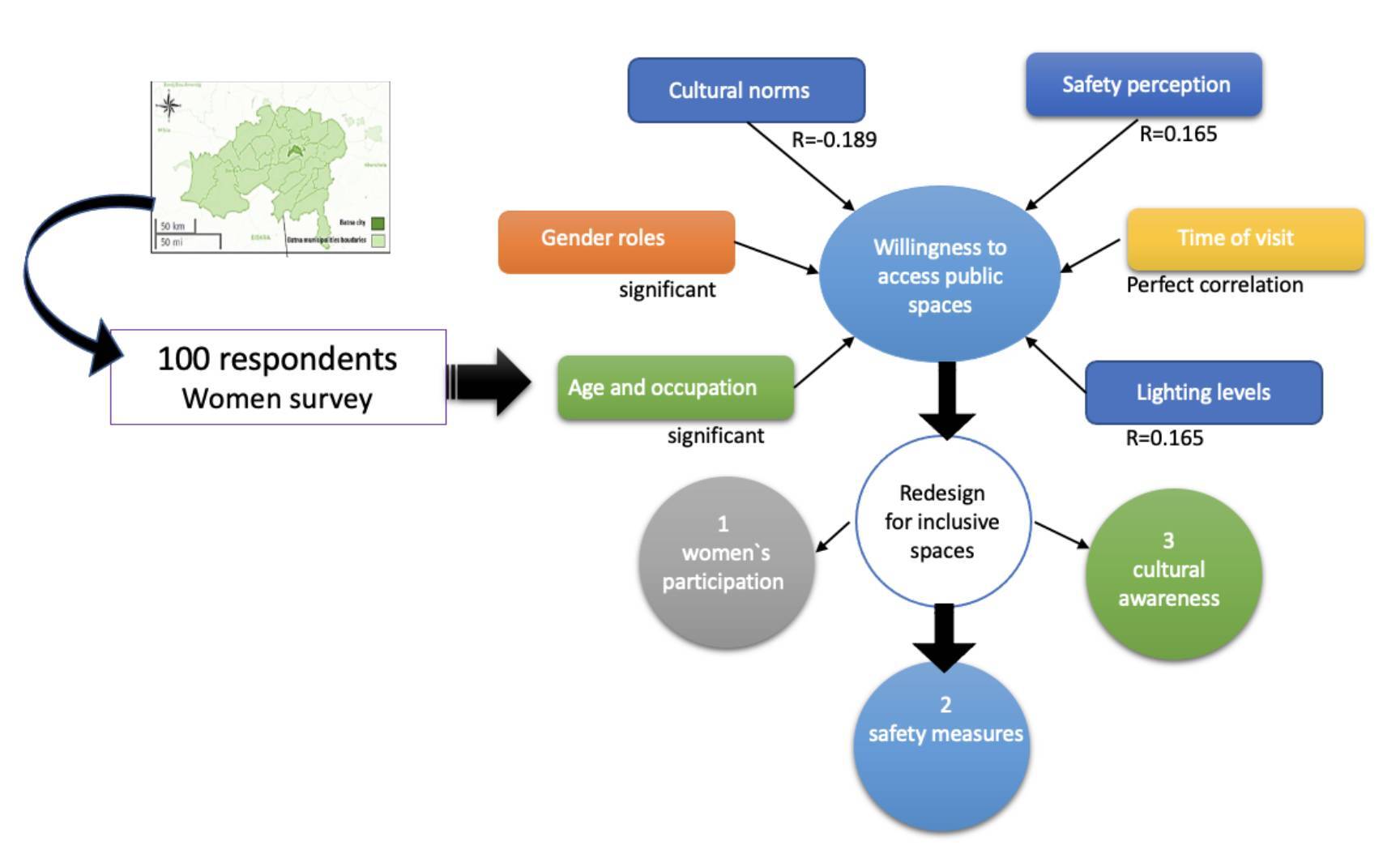
FINDINGS: The results show strong associations between women’s use of public space and multiple interrelated factors. A significant correlation was found between the frequency of visits and age/occupation. Cultural barriers were identified as the most influential factor limiting access, followed by inadequate infrastructure and perceived insecurity. Negative correlations were observed for perceptions of equal access (r = –0.167, p = 0.098) and women’s access to the Ben-Boulaid alleys (r = –0.189, p = 0.060), indicating exclusion from certain spatial practices. Lighting was positively correlated with reduced fear of aggression (r = 0.165). Furthermore, 72% of respondents judged current gender equality measures as insufficient. These results confirm the hypothesis and emphasize the urgent need to integrate gender indicators into urban planning practices.
CONCLUSION: This research highlights the importance of rethinking urban policies through a gender lens, incorporating women’s lived experiences and spatial needs into the design process. It calls for participatory placemaking strategies that promote safety, inclusivity, and cultural sensitivity, aiming to foster public spaces that are accessible, welcoming, and equitable for all.
Graphical Abstract
Keywords
Subjects
OPEN ACCESS
©2026 The author(s). This article is licensed under a Creative Commons Attribution 4.0 International License, which permits use, sharing, adaptation, distribution and reproduction in any medium or format, as long as you give appropriate credit to the original author(s) and the source, provide a link to the Creative Commons license, and indicate if changes were made. The images or other third-party material in this article are included in the article’s Creative Commons license, unless indicated otherwise in a credit line to the material. If material is not included in the article’s Creative Commons license and your intended use is not permitted by statutory regulation or exceeds the permitted use, you will need to obtain permission directly from the copyright holder. To view a copy of this license, visit:
http://creativecommons.org/licenses/by/4.0/
PUBLISHER NOTE
Tehran Urban Research & Planning Centre (TURPC) takes a neutral position about claims on disputed territories, place names, international boundaries, jurisdiction in published maps, and institutional affiliations. TURPC is committed to retracting a paper after its publication if it becomes apparent that there are serious problems in its content, in terms of research and publication ethics (https://www.ijhcum.net/journal/process?ethics).
CITATION METRICS & CAPTURES
Google Scholar | DOAJ | Scopus | EBSCO | Internet Archive |Twitter |Mendeley
CURRENT PUBLISHER
Tehran Urban Research and Planning Center: Tehran Municipality